
Welcome to Ballinamore, County Leitrim

Ballinamore, also known as Béal an Átha Móir, meaning “mouth of the big ford,” got its name because it was the main crossing point of the Yellow River, situated between St. John’s Lough and Garadice Lough. This area is now part of the Ballinamore-Ballyconnell Canal, which was constructed in the 1840s to link the River Erne with the River Shannon. The canal was officially opened in 1860, but it was not a commercial success and quickly fell into disrepair. However, in 1994, it was restored as the Shannon-Erne Waterway, and today it attracts many tourists to the town of Ballinamore.
The town is situated in drumlin country at the foot of Sliabh an Iarainn and dates back to the 1621 Plantation of Leitrim, when English and Scottish settlers arrived. In that year, a grant of 600 acres of land was made to Sir Fenton Parsons, who undertook the task of building the nucleus of a town. In the 19th century, the town changed very little. It consisted of one short business street, Main Street, and three side streets: Chapel Lane (now St. Brigid’s Street), Church Lane (now Church Street), and Pound Lane (High Street was known as Cannaboe). Between 1900 and 1930, the town adopted the layout it has today. The thatched houses gradually disappeared, and many of the town’s better houses were built. Cannaboe extended to meet the railway station and became known as High Street.
On 24th October 1887, Ballinamore Railway Station opened as the headquarters of the narrow gauge Cavan & Leitrim Railway. It was the point where the line from Dromod, through Mohill and Ballinamore to Belturbet, branched off to Kiltubrid, Drumshanbo, and Arigna. However, on 1st April 1959, Ballinamore Railway Station closed, resulting in the loss of over sixty jobs, which was a significant blow to the town’s economy. The fine red-bricked station building still survives today and can be found at the top of the town.
What is the history of Ballinamore, County Leitrim

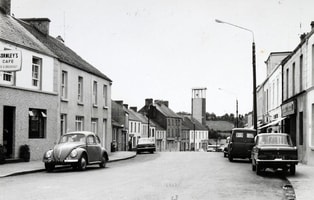
Ballinamore Courthouse is located in the center of the town. Built in the 1830s, it is a two-storey, three-bay building, with the central bay being the focal point. In addition to serving as a courthouse, the building also housed a bridewell (a type of jail) and residential quarters for the keeper of the bridewell. It is the town’s most prominent cut-stone building. In 2016, a commemorative plaque was placed on the outside of the courthouse to mark the Easter Rising of 1916. The oldest building in the town is the Church of Ireland, located on Church Street. It was built in the 1780s using materials from the ruins of the local Roman Catholic Church (St. Patrick’s), which was demolished during the Reformation and under the Penal Laws. Nearby is the Oughteragh (Church of Ireland) parish school.
Ballinamore Heritage Trail: Six monoliths are located around the town which detail the history and heritage of the area. Points along the trail include: The Old Barracks, The Courthouse and The Ballinamore Railway. Ballinamore is widely acknowledged as an angler’s paradise – with 28 lakes within 5 mile radius and some 17 km of riverbank, Ballinamore has hosted numerous national and international angling competitions, most recently the world pairs angling championship.
Ballinamore has daily Local Link bus services to Dromod railway station, Carrick on Shannon and Cavan, Monday to Saturday, timetable for this local link can be found on display in the Ballinamore Tourism Office.